
“How long do channel letters last?” is a reasonable question with an unreasonable expected answer. There is no single number, because a channel letter is five assemblies with five different failure clocks, and the sign lasts until the first component that cannot be serviced becomes the reason to replace it. A more useful answer breaks the question into parts: what each component typically gives, what shortens it, and what makes a repair possible instead of a rebuild.
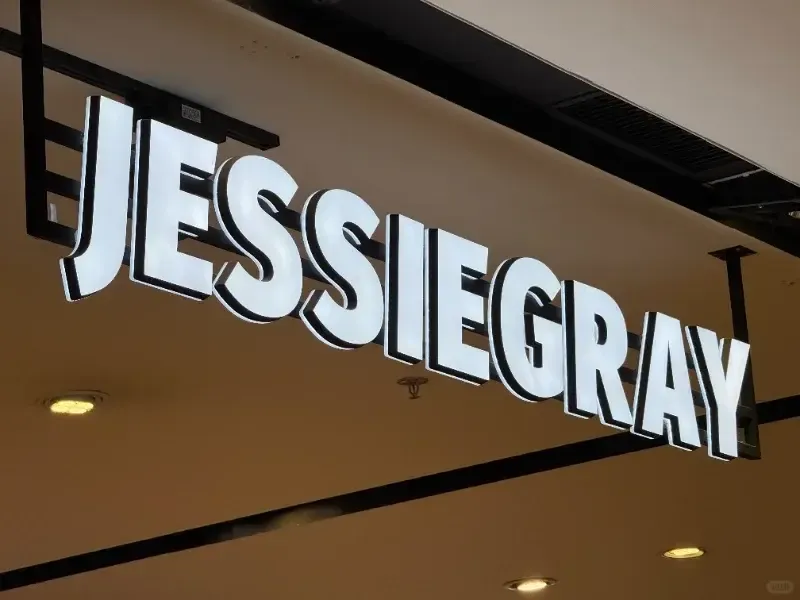
The component clocks inside one letter
Face
A 3 mm cast acrylic face is the most durable element in the assembly and the most exposed. In a temperate climate it commonly holds colour and impact resistance for eight to twelve years; in strong sun with high UV it yellows earlier, and near the coast salt deposition dulls it faster unless it is washed periodically. Face failure is usually mechanical rather than optical — a cracked corner from an impact, or a trim that has loosened — and a trim-cap face can be replaced on its own.
Return and coating
The aluminium return does not corrode quickly, but the coating on it does. A powder-coated return in an inland climate typically reads well for eight to fifteen years; a coastal site with salt air, or an industrial area with sulphur, shortens that noticeably, and a dark colour shows chalking sooner than white. Coating failure starts at edges, seams and fixing points, which is exactly where water sits.
LED modules
Module ratings are usually stated as 50,000 to 100,000 hours to a percentage of initial output, not to failure. In practice the modules outlive the driver and often outlive the face. What kills them early is heat: a shallow return with modules pushed close to the face, a sealed letter with no ventilation path, or a driver running at its limit inside the same enclosure.
Driver
The power supply is normally the first electrical component to fail, and the replacement interval commonly runs five to ten years depending on load, ambient temperature and position. A driver inside a sealed letter in direct sun runs hotter than the same unit in a shaded raceway, and heat is the main accelerator. Ask for the driver's rated operating temperature and its position on the drawing.
Back panel and fixings
The back panel closes the letter and carries the load. A 2–3 mm aluminium composite or sheet panel with studs fixed at the drawing's pattern is normal; what matters is that the studs land on structure the installer has confirmed, and that the panel does not flex when a letter 1 m tall is tightened down. Fixings are the least glamorous part of the assembly and the one most likely to be improvised on site, which is why the stud pattern belongs on the drawing rather than in a conversation.
Wiring and connections
Branches, connectors and cable exits fail through water rather than through current. A connection that stays dry lasts as long as the sign; one that collects condensation at a cable exit can corrode within a couple of seasons. Sealed glands, drip loops and exits positioned below the letter's water path are the details that decide this.
What the site does to all five clocks
Four environmental factors move every number above:
- Coastal salt air. Accelerates coating breakdown and connector corrosion; specifies 316-grade stainless for exposed hardware and a marine-grade coating.
- Strong UV and heat. Yellows acrylic, chalks dark coatings and raises the temperature inside every enclosure.
- Freeze–thaw cycling. Drives water into seams and cable entries, where it expands.
- Pollution and dust. Deposits on faces and in drainage paths, reducing output and trapping moisture.
A specification that is adequate inland can be marginal on a coastal facade, and the difference is usually decided at the hardware and sealing level rather than in the LED selection.
Service access is the real lifespan multiplier
Two identical signs in identical conditions can have very different effective lives. The one whose driver can be reached in a raceway, whose faces open with trim caps, and whose branches are labelled will be repaired for a decade. The one with a sealed trimless face, a driver buried behind the back panel and unlabelled wiring will be replaced the first time a single module fails, because the labour to reach it approaches the labour to replace the set.
This is a design decision, not a maintenance one, and it is settled at drawing approval. The questions worth asking then are concrete:
- Can each letter be opened without removing the letter from the wall?
- Is the driver in an accessible position, and is that position on the drawing?
- Does every letter carry an identifier that matches the wiring diagram and the packing list?
- Are spare modules and a spare driver supplied, with the same colour temperature and bin?
A maintenance schedule that actually extends life
| Interval | Task | What it prevents |
|---|---|---|
| Every 6 months | Visual check of faces, seals and cable exits; remove debris from drainage paths | Water ingress, insect nests, blocked drainage |
| Every 12 months | Wash faces and returns with plain water and a soft brush; inspect coating edges and seams | Salt and pollution build-up, early coating failure |
| Every 12–24 months | Night illumination check: compare letter-to-letter brightness and colour | Failing modules or a branch running below output |
| Every 24 months | Inspect driver enclosure, connections and glands; verify earth and supply | Connector corrosion, loose terminations |
| At first sign of flicker | Identify the branch and replace the module or driver before the face is affected | A local fault becoming a full-branch failure |
The schedule is deliberately front-heavy: the cheap tasks are the frequent ones, and most expensive repairs begin as a five-minute seal inspection skipped for three years. Photograph the installation at commissioning and file the images with the drawing — a brightness comparison two years later is only meaningful against a baseline.
Repair or replace
The decision point is rarely the face. It is usually one of three:
- One branch, one letter. Replace the module or driver; the sign continues.
- Several branches failing within a year, with coating still sound. A full LED and driver refresh is usually worth it, particularly if the faces are still clear.
- Faces yellowed, coating failing at seams and multiple branches out. At this point the labour and parts approach a new set, and a replacement with the current construction is the better route.
The judgement is easier with records. A project file holding the approved drawing, the component references, the wiring groups and the as-built photographs lets a service team identify a part before opening unrelated letters — and lets a repeat order match the original build instead of approximating it.
Lead time and replacement planning
Lifespan planning has a scheduling side. A replacement set is not available the week a branch fails: production typically runs 3–7 working days after drawing release, and freight adds its own transit time on top. For a multi-site programme the sensible approach is to keep a small spares kit — one module per colour temperature, one driver per capacity, a spare face for the most exposed letter — and to hold the approved drawing so a repeat order can be released without a new design cycle.
Where a set is part of a phased rollout, the repeat order should reference the approved revision rather than the phrase “same as last time”. A revision number, a component list and a colour reference are what make the second set match the first three years later.
Frequently asked questions
Does an LED module's rated life describe the whole sign?
No. It describes the module's output over time under test conditions. Faces, coatings, drivers, connectors and installation conditions each have their own interval, and the sign's practical life is set by the first failure that cannot be serviced cheaply.
Do halo-lit letters last longer than front-lit ones?
Not inherently. Halo letters run cooler at the face because the light is aimed at the wall, which can be kinder to acrylic, but they depend more on the wall surface and on standoff sealing. Longevity comes from construction and access, not from the lighting direction alone.
Is a ten-year warranty realistic?
Be cautious with any single figure covering the whole assembly. Ask what is covered — modules, driver, coating, labour — and for how long each element is covered. A warranty that covers one component tells you little about the sign.
What is the single most useful thing to specify for a long-life sign?
Access. A sign that can be opened, whose driver can be reached and whose branches are labelled will be maintained; one that cannot will be replaced early. Specify access at drawing approval, when it is still free.
Send the facade conditions, the intended service arrangement and the expected service life, and the construction can be specified around them rather than around a generic promise. The sign maintenance schedule covers the annual routine, the wholesale channel letter programme covers repeat sets built to a released drawing, and the manufacturing stages show where access is decided.


