The sign runs eight hours a night, not eight hours a day
A shop sign is lit for a few hours after dusk. A bar sign starts at 20:00 and is still on at 03:00, every night, and often at full output the whole time. Over three years that is roughly 8,000-9,000 hours - close to the point where a cheap module has lost a noticeable share of its output and every poorly sealed driver has failed once.
Two specification habits follow from that. Modules should be run below their maximum rating, with the driver sized for the actual load rather than the theoretical one, because a supply at 95% of capacity in a sealed raceway is the first thing to fail. And the thermal path matters more than the IP number: a letter that cannot shed heat will cook its own modules long before water gets in.
The colour also shifts over those hours. Deep reds and magentas fade first on low-cost acrylic, so a face that looked right at handover reads pink at year two. Cast acrylic with a UV-stable pigment, rather than extruded sheet, is the difference between a two-year sign and a six-year one.
Halo, front-lit, or exposed neon: three effects, three failure profiles
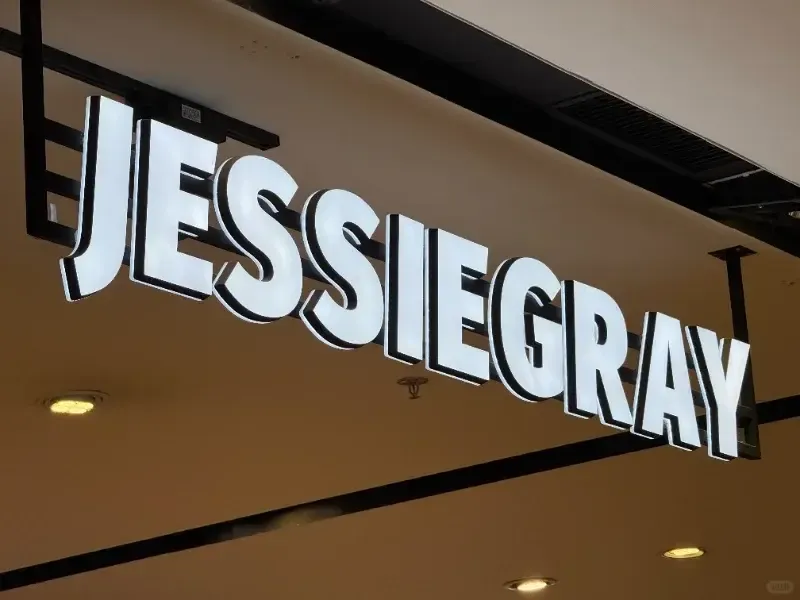
On a dark facade, halo-lit letters read as a silhouette cut out of the wall, which is the effect most premium bars want. Front-lit letters read as a solid block of brand colour, which suits a loud, graphic identity. Exposed LED neon as an outline or a script element adds a second layer without changing the letter construction.
Each has a different failure mode, and the maintenance plan should match. A halo sign fails as a dark patch behind one letter, which is visible but not catastrophic; the usual cause is a module or a driver, and it can wait until morning. A front-lit sign fails as a hot spot or a dim face, which reads as cheap immediately. Neon accent fails as one dark segment, and on a busy sign that is easy to miss until half the outline has gone.
Glass neon belongs in the conversation only as a caution: it is fragile, runs at high voltage, needs a transformer per circuit, and in most cities cannot be repaired quickly at 01:00. LED neon in a silicone or PVC profile gives the same line quality with 24V, no glass, and a segment that can be replaced by a technician with a screwdriver.
For the sign that goes inside the room rather than on the facade, the build is different: see neon signs for bars and lounges.
Colour that holds on a wet street
Two things happen to colour at night on a bar frontage. Saturated blue and violet lose apparent brightness as the eye shifts into night vision, so a sign that looks electric in a design render can read as a dark smear on the wall. And wet pavement doubles the sign: the reflection is not a bonus, it is a second light source competing with the letter itself, which is why a well-lit bar looks better in rain and a badly lit one looks worse.
The practical answer is not more output. It is larger lit area, tighter spacing between letters, and a colour that contrasts with the wall rather than with the pavement. On a black-painted facade, warm white, amber, magenta and lime all hold; deep blue and dark green disappear. On a pale rendered wall the relationship inverts and dark faces with a bright halo work best.
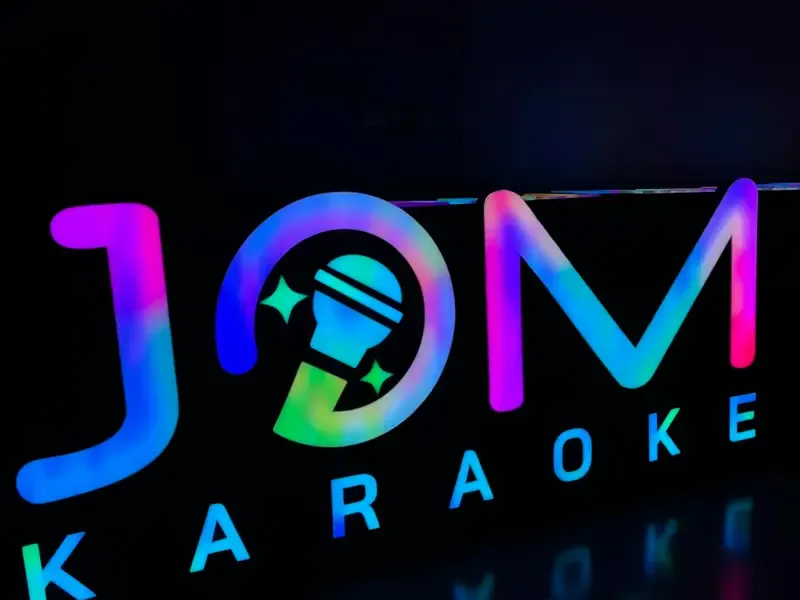
If the venue changes its identity by season or by event, RGB gives that flexibility - with the same caveats as any RGB sign: a fixed white channel if the brand uses white, module spacing set for full three-channel output, and a controller that returns to the default scene after a power cut rather than sitting on whatever was last selected.
Water, wind and a facade that is older than the sign
Bars occupy the buildings that were cheap enough to lease: brick, glazed tile, timber, decorative cornices, and walls that were never designed for a raceway. Drilling into a 1920s cornice or a tiled pier is the point where a sign project goes wrong, and it goes wrong quietly - a cracked tile is not visible until the scaffold comes down.
Where the wall cannot be penetrated freely, a raceway that spans between sound fixing points, a projecting blade sign on its own frame, or a standoff panel that carries the letters and distributes the load are the alternatives. Every fixing into masonry should be an engineered anchor rated for the pull-out load, not a plastic plug chosen by whoever is on the ladder.
Water is the other permanent condition. Exposed walls take driving rain, and street cleaning crews spray the base of the facade at 06:00. IP65 is the floor; IP66 for letters within a metre of the pavement or under a canopy edge where water concentrates. The chamber needs a drainage path or a fully sealed volume with a gasket, not a half-open return that fills and holds water against the modules.
Bass, vibration and what shakes loose
A nightclub facade is a large diaphragm. Subwoofers inside the building move the wall, and the sign is bolted to it. Over a year of nightly sets, the failure is rarely electrical - it is a module clip that walks out of its channel, a screw that backs off half a turn, or a neon segment that starts to buzz against its profile.
Three details prevent most of it: thread-locking compound or nylon-insert nuts on anything that carries a letter, module retention that clips rather than relies on adhesive tape, and a rubber or EPDM gasket between the letter return and the wall so the shell is not rigidly coupled to the plaster. On a sign mounted over a stage or a dance floor, isolating the frame from the stud wall is worth doing at the drawing stage, not after the first complaint about a rattle.
Heat is the companion problem. A sealed letter over a hot, crowded room sits in warmer air than the datasheet assumed, and the driver in a closed raceway sees that ambient too. Moving the driver to a ventilated location or a remote enclosure is usually the cheapest reliability decision in the whole build.
Scenes, closing time and service at 3am
Bar lighting is a schedule, not a switch. A workable four-scene setup covers most venues: pre-open warm at 40%, service peak at 100%, late at 60% with the accent layer shifted, and closed at 10% or off with a small halo left on the door.
The controller has to be somewhere staff can reach without a ladder, and it has to survive a power cut by returning to the default scene. A sign stuck on a test colour at 23:00 because someone pressed the wrong button is a problem that repeats weekly until the controller is replaced.
Service access is the part that gets designed last and matters most. Decide before production how a face comes off at 5 m above a pavement, whether the raceway has a removable cover instead of a sealed lid, and which spare modules ship with the set - binned by colour and by batch, because a replacement from a different bin is visible on a saturated face. Late-night venues also need a maintenance window that is not opening hours, so a sign that can be serviced from a single access point in twenty minutes will actually get serviced.
Finally, cleaning: smoke, fryer grease from a neighbouring kitchen and road dust build a film on the face that cuts output far more than module ageing does in the first years. A twice-yearly wash with a non-solvent cleaner belongs in the handover pack.