CHANNEL LETTER TECHNICAL GUIDE
Front Lit vs Halo Lit Channel Letters: What’s the Difference?
Compare illumination direction, construction, mounting conditions and commercial applications before approving a custom channel letter project.
- Front-face illumination vs reflected rear halo
- Mounting and wall conditions reviewed before fabrication
- Buyer inputs that affect construction and installation
QUICK COMPARISON
The Difference in One View
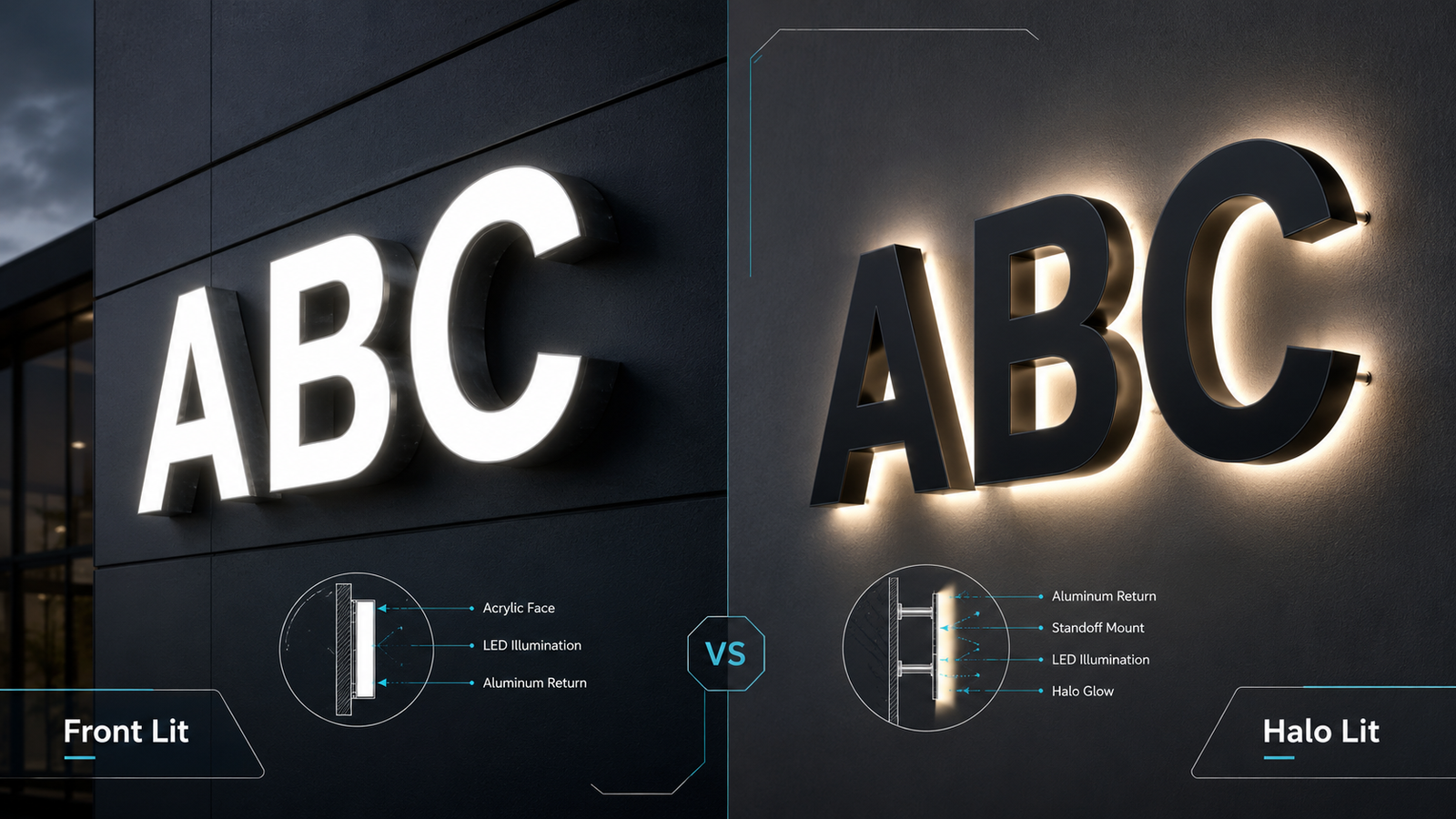
The main difference is where the light is directed. That choice also changes the face construction, wall interface, mounting and final visual effect.
FRONT LIT
Direct Face Illumination
Front lit channel letters use internal LED modules and a translucent face to direct illumination toward the viewer.
- Light exits through the front face
- Strong direct nighttime visibility
- Less dependent on wall reflection
- Common for storefronts and commercial facades
HALO LIT
Reflected Rear Illumination
Halo lit channel letters direct illumination toward the mounting surface so reflected light creates a halo around the letter.
- Light is directed toward the wall
- Creates a reflected halo around the letter
- Requires controlled rear spacing
- Common for architectural and premium branding
TECHNICAL COMPARISON
Front Lit vs Halo Lit Channel Letters: Main Differences
Choosing between front lit and halo lit channel letters is not only an aesthetic decision.
The illumination direction affects the letter construction, mounting method, wall interface, cable routing and the way the finished sign appears during both daytime and nighttime conditions.
For sign companies, contractors and commercial buyers, these details are worth confirming before drawings are approved and fabrication begins.
| Project Factor | Front Lit | Halo Lit |
|---|---|---|
| Illumination | Through the front face | Toward the wall behind the letter |
| Night Appearance | Bright illuminated letter face | Reflected halo around the letter |
| Wall Involvement | Less dependent on wall reflection | Wall becomes part of the lighting effect |
| Typical Face | Translucent illuminated face | Often opaque or metal depending on construction |
| Mounting | Direct, raceway or project-specific | Requires controlled spacing from the wall |
| Surface Sensitivity | Moderate | Higher |
| Visual Character | Strong visibility | Architectural and refined |
| Engineering Focus | Face illumination and legibility | Standoff, reflection and halo consistency |
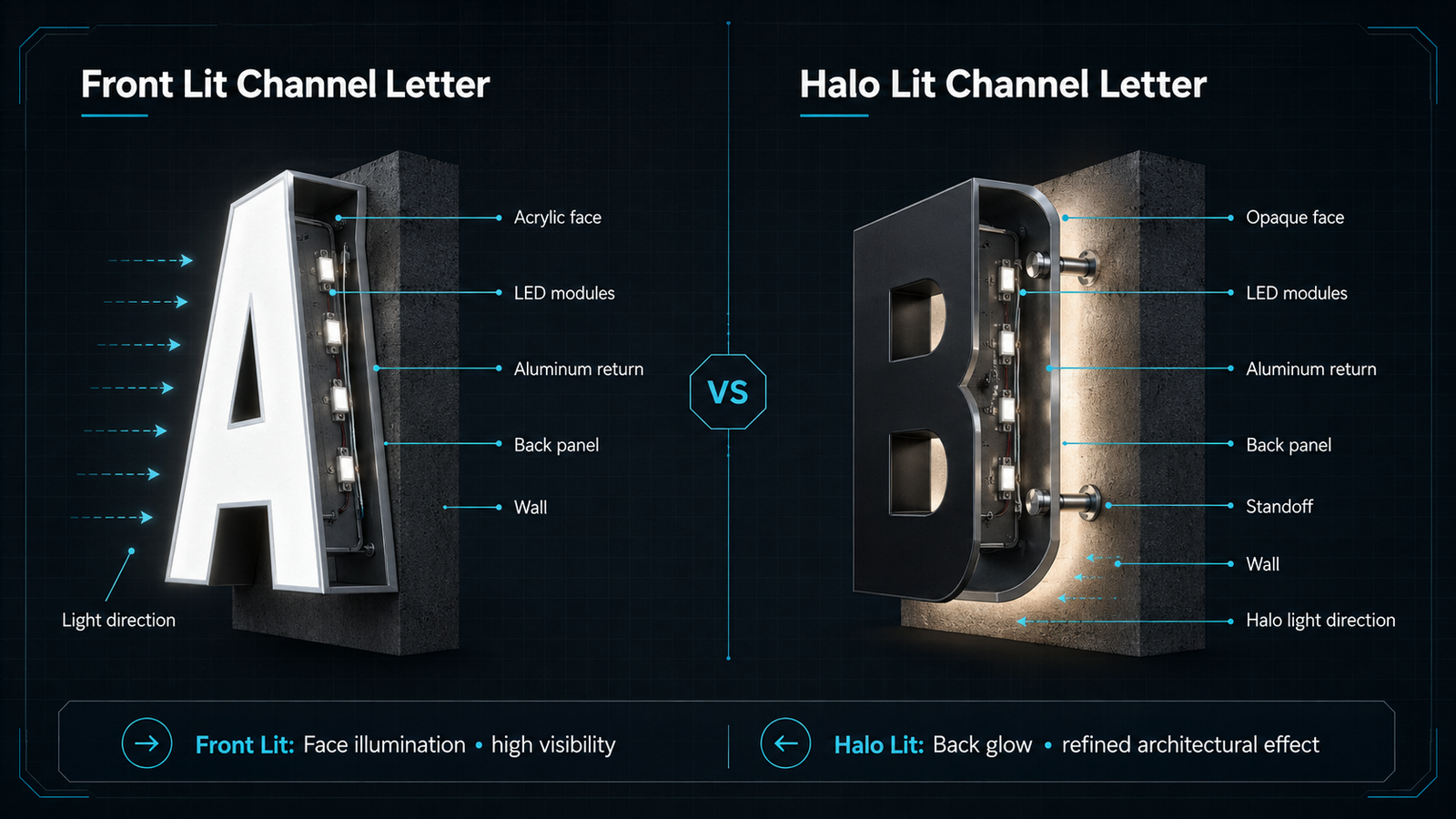
Buyer note: Wall condition matters more with halo-lit letters because the mounting surface becomes part of the lighting system. Texture, color, reflectivity and standoff distance can all change the visual result.
What About Front-and-Back Lit Channel Letters?
A third option combines the two effects. These signs may be described as front-and-back lit, face-and-halo lit, dual-lit or combination-lit channel letters.
The face produces direct illumination while light from the rear creates a halo around the sign. This can create stronger visual separation, but face color, halo color, wall condition, letter depth, wiring and mounting distance all need to be coordinated together.
APPLICATION FIT
Where Each Lighting Style Makes More Sense
The best choice depends on viewing distance, architecture, wall condition and the visual role of the sign.
FRONT LIT · BEST FIT
Visibility-Led Commercial Signage
Front lit letters are typically useful where the illuminated face needs to remain visually clear from a greater viewing distance.
- Retail storefronts
- Shopping centers
- Commercial facades
- Long-distance viewing conditions
HALO LIT · BEST FIT
Architectural Brand Presentation
Halo lighting is often selected where dimensional separation and reflected illumination are part of the architectural presentation.
- Hotels and hospitality
- Office reception walls
- Premium retail interiors
- Architectural feature walls
MOUNTING & SITE INTERFACE
Mounting Changes How the Sign Is Engineered
Lighting style and mounting method should be reviewed together before production drawings are approved.
01
DIRECT / FLUSH
Coordinate the Wall Interface
- Stud or fixing locations
- Cable exit positions
- Wall penetration references
02
RACEWAY / BACKER
Consolidate Mounting and Wiring
- Support geometry
- Power and wiring access
- Installer fixing references
03
HALO STANDOFF
Control Rear Light Spread
- Standoff distance
- Wall texture and color
- Halo consistency and service access
A front lit sign may be configured for direct mounting, a raceway, a backer panel or another project-specific support arrangement. Halo lit letters require particular attention to the spacing between the letter and the wall because that space allows the reflected illumination to develop.
A useful production drawing should therefore show more than overall sign dimensions. Mounting points, cable exits, wall interface, sign depth and installer references should be coordinated before fabrication begins.
PridLED’s engineering and manufacturing support is structured around identifying these project interfaces before production release.
BEFORE MANUFACTURING
What Buyers Should Confirm Before Production
A useful quotation and production drawing depend on project inputs being identified before fabrication starts.
ARTWORK & SIZE
Final artwork, target dimensions, quantity and relevant brand references.
SITE CONDITIONS
Indoor or outdoor environment, wall material, fascia construction and available site photos.
MOUNTING
Direct mount, raceway, backer, standoff requirements and cable exit positions.
ELECTRICAL
Destination voltage, power-supply location, wiring route and service access.
FINISH & LIGHTING
Required illumination style, face and return finish, color references and expected wall interaction.
INSTALLER REFERENCE
Installation drawings, elevations, mounting templates or local installer requirements where available.
BUYER DECISION
Front Lit vs Halo Lit: Which Should You Choose?
There is no single lighting style that is better for every channel letter project.
Choose front lit channel letters when the project places more emphasis on a directly illuminated face, strong readability and longer viewing distances.
Choose halo lit channel letters when the project calls for reflected illumination, dimensional separation from the wall and a more architectural presentation.
Consider front-and-back lit letters when both direct face illumination and a surrounding halo are required.
The most reliable decision comes from reviewing the lighting goal together with the actual installation conditions. The sign should be selected around the wall, mounting method, viewing distance, wiring and maintenance requirements—not only around a reference image.
Before quotation, PridLED can review artwork, dimensions and installation inputs through the engineering and manufacturing support process.
CHANNEL LETTER FAQ
Common Questions About Front Lit and Halo Lit Channel Letters
Clarify common terminology, mounting conditions and project inputs before moving into quotation or production review.
Are halo lit and reverse lit channel letters the same?
In common sign-industry terminology, halo lit, reverse lit and backlit channel letters generally describe the same lighting concept: light is directed behind the dimensional letter and reflected from the mounting surface to create a halo effect.
Are front lit channel letters the same as face lit channel letters?
Generally, yes. Both terms describe letters where illumination is visible through the front face. The exact materials and construction can vary by manufacturer and project.
Can halo lit channel letters be installed on any wall?
They can be engineered for many mounting conditions, but the wall should be reviewed before production. Surface texture, color, geometry, reflectivity and standoff distance can all affect the appearance of the halo.
Can channel letters illuminate both the face and the back?
Yes. Front-and-back lit, dual-lit or combination-lit channel letters use front illumination together with rear halo illumination. Both lighting effects should be coordinated with the mounting surface and electrical layout.
What information should I send before requesting a channel letter quote?
Send the artwork, target dimensions, quantity, installation environment, wall or fascia information, destination, voltage requirements and available site photos. These inputs help identify construction and mounting requirements before quotation.
CHANNEL LETTER PROJECT REVIEW
Planning a Channel Letter Project?
Send your artwork, dimensions, installation surface and project requirements. PridLED can review the key construction, mounting and electrical inputs before quotation and production release.