
CHANNEL LETTER MOUNTING GUIDE
Raceway vs Flush Mount Channel Letters: Which Mounting Method Fits Your Project?
Compare raceway mounted and flush or direct mounted channel letters by mounting structure, wall interface, wiring access and installation requirements before fabrication.
- Raceway mounting consolidates letters and wiring on one support
- Direct mounting creates a cleaner individual-letter appearance
- The right method depends on the wall, wiring and installer scope
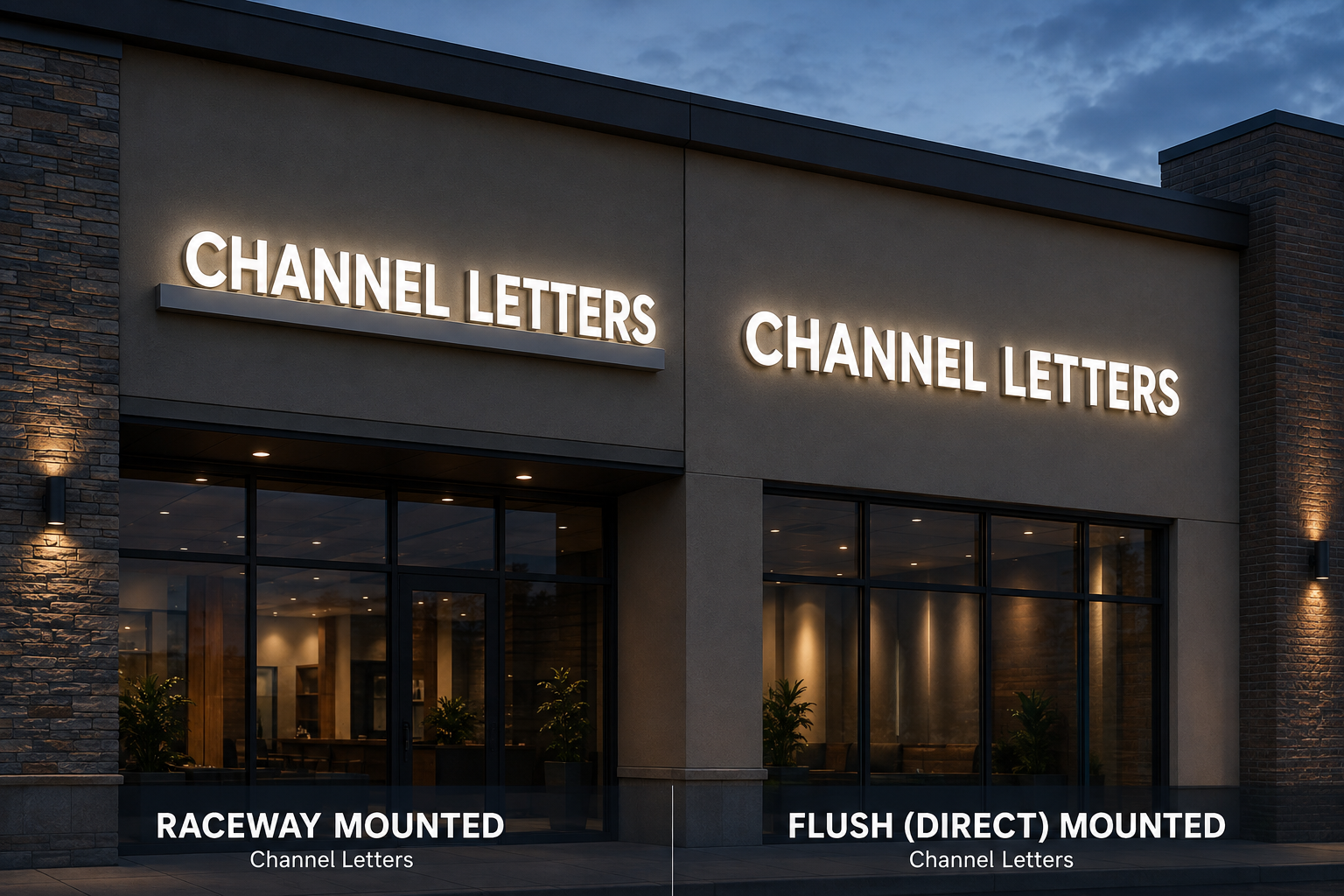
QUICK COMPARISON
Raceway Mounted vs Flush Mounted at a Glance
Both methods can support illuminated channel letters, but they organize mounting points, wiring and the wall interface differently.
RACEWAY MOUNTED
Letters Mounted to a Shared Support
The individual letters are attached to a fabricated raceway or backer that becomes the main interface between the sign and the building.
- Wiring can be organized inside the raceway
- Fewer primary wall mounting locations may be required
- Raceway finish can be coordinated with the facade
- Useful where wall access or cable routing is limited
FLUSH / DIRECT MOUNTED
Individual Letters Mounted to the Wall
Each channel letter is mounted directly to the wall or fascia rather than being carried by a visible shared raceway.
- Cleaner individual-letter appearance
- Each letter needs defined mounting locations
- Wiring exits must be coordinated with the wall
- Best suited to walls that can support the required interfaces
MOUNTING STRUCTURE
How Raceway and Direct Mounting Work
The mounting method affects more than appearance. It determines how the letters, wiring and building surface interface with one another.
How Raceway Mounted Channel Letters Work
With raceway mounting, the channel letters are assembled onto a fabricated aluminum support before installation. Low-voltage wiring and related connections can be organized within that structure, while the raceway itself is fixed to the building.
This can simplify the number of individual sign-to-wall interfaces and can be useful where the installer needs a defined mounting assembly rather than separate mounting points for every letter.
How Flush or Direct Mounted Channel Letters Work
With direct mounting, each channel letter is positioned and fixed individually to the building surface. Wiring normally exits from each letter or from defined cable locations behind the sign and must connect to the site electrical arrangement.
The finished facade can appear cleaner because there is no visible raceway, but the wall condition, mounting pattern and cable exits generally require more precise coordination.
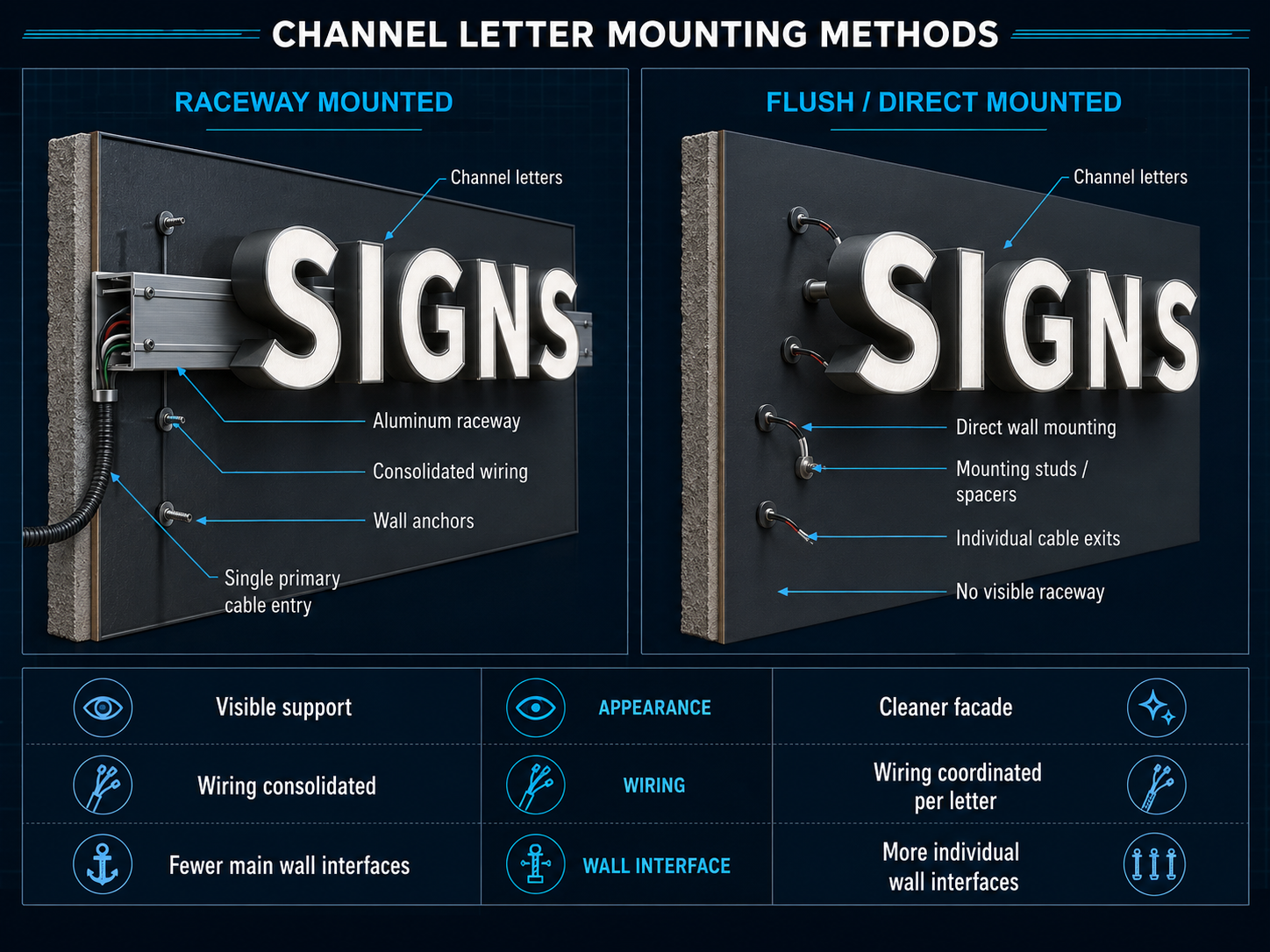
Buyer note: Direct mounting is not automatically better simply because the raceway is hidden. A clean appearance depends on the wall being suitable for individual fixing points, cable penetrations and accurate letter alignment.
MAIN DIFFERENCES
Raceway vs Flush Mount Channel Letters: Technical Comparison
The correct mounting method should be selected around the building condition and installation plan rather than appearance alone.
| Project Factor | Raceway Mounted | Flush / Direct Mounted |
|---|---|---|
| Mounting Structure | Letters attach to a shared raceway or backer | Letters attach individually to the wall or fascia |
| Visual Appearance | Raceway remains visible unless concealed by the design | No visible shared raceway behind the letters |
| Wiring | Wiring can be consolidated within the raceway | Individual cable exits require wall coordination |
| Wall Interface | Main structural interface is concentrated at the raceway | Each letter requires defined mounting and cable locations |
| Installation Alignment | Letters can arrive pre-aligned on the support assembly | Individual letters must be positioned accurately on site |
| Service Access | Raceway may centralize part of the wiring access | Access depends on each letter and the site wiring arrangement |
| Facade Impact | Useful where penetrations or wiring need consolidation | Cleaner facade when the wall supports direct mounting |
| Typical Project Fit | Retrofits, uneven access conditions and projects needing a defined support assembly | Architectural facades and projects prioritizing individual-letter appearance |
WALL & ELECTRICAL INTERFACE
Three Site Conditions That Change the Mounting Plan
The mounting method should be coordinated with the building surface, cable route and future service access before the production drawing is released.
01
WALL STRUCTURE
Confirm What the Sign Is Fixing To
- Facade or wall material
- Available structural support
- Permitted penetration locations
02
POWER & CABLE ROUTE
Define Wiring Before Fabrication
- Destination voltage
- Power-supply location
- Cable exit and penetration points
03
SERVICE ACCESS
Plan for Future Maintenance
- Driver or power-supply access
- Letter removal requirements
- Installer access after handover
PROJECT FIT
When Raceway or Direct Mounting Makes More Sense
Neither method is automatically better. The more suitable choice depends on how the building and installation conditions support the sign.
RACEWAY · GOOD FIT WHEN
Installation Needs a Shared Support
- Multiple letters need to arrive pre-aligned
- Wiring needs to be consolidated within one assembly
- Wall access behind each individual letter is limited
- The project is a retrofit or tenant improvement
- A defined serviceable support assembly is preferred
DIRECT MOUNT · GOOD FIT WHEN
The Wall Supports Individual Letter Interfaces
- A clean no-raceway appearance is required
- The wall or fascia can accept individual fixing points
- Letter locations can be accurately transferred to the site
- Electrical routing can be coordinated behind the facade
- The architectural finish should remain visually minimal
BEFORE QUOTATION
What Buyers Should Send Before the Mounting Method Is Finalized
Mounting decisions become more reliable when the sign drawing and actual installation surface can be reviewed together.
ARTWORK & DIMENSIONS
Final artwork, overall sign dimensions, letter height, quantity and relevant brand references.
WALL / FASCIA
Elevation drawing, wall material, facade construction and available structural information.
SITE PHOTOS
Straight-on facade photos, wider site context and close views of the intended mounting surface.
POWER & CABLE ACCESS
Available cable exit locations, power-supply position and intended electrical access behind or near the sign.
VOLTAGE & DESTINATION
Destination country or region, project voltage and any project-specific electrical requirements supplied by the buyer or installer.
INSTALLER INPUT
Local installation requirements, mounting preferences and access constraints where they are already known.
LOCAL INSTALLER SCOPE
Separate Manufacturing Inputs From Site Installation Responsibilities
For international projects, the production drawing should make the factory scope clear while leaving site-specific fixing and electrical work to the responsible local installer.
MANUFACTURING SUPPORT
What PridLED Can Prepare for Production Handover
- Production drawings based on approved project inputs
- Mounting pattern or installation reference where applicable
- Raceway or backer dimensions when included in the sign construction
- Cable exit and sign wiring references
- Hardware groups and project-specific packing identification
SITE INSTALLATION
What the Local Installer Typically Confirms
- Actual wall or structural condition at the installation site
- Final fixing method suitable for the building
- Site electrical connection and power availability
- Access equipment and installation sequence
- Local permits, codes or site requirements where applicable
BUYER DECISION
Raceway vs Flush Mount: Which Should You Choose?
There is no single mounting method that is right for every channel letter project.
Choose raceway mounted channel letters when the project benefits from a shared support structure, consolidated wiring, pre-aligned letters or fewer primary interfaces between the sign assembly and the building.
Choose flush or direct mounted channel letters when the building can support accurate individual mounting points and cable exits, and the design calls for a cleaner facade without a visible raceway.
The mounting method should also be considered together with the lighting style. Front lit, halo lit and combination-lit letters can create different wiring, wall-spacing and service requirements. See our Front Lit vs Halo Lit Channel Letters guide if the illumination type has not yet been finalized.
Before production, PridLED can review the artwork, dimensions and available installation information through the engineering and manufacturing support process.
CHANNEL LETTER MOUNTING FAQ
Common Questions About Raceway and Flush Mounted Channel Letters
Clarify mounting structure, wiring, wall requirements and project inputs before approving the installation approach.
What is the difference between raceway mounted and flush mounted channel letters?
Raceway mounted letters are attached to a shared fabricated support that is then fixed to the building. Flush or direct mounted letters are positioned and fixed individually to the wall or fascia without a visible shared raceway.
Is a raceway mounted sign easier to install?
It can simplify some projects because the letters can arrive assembled and aligned on one support, with wiring consolidated inside the raceway. Actual installation difficulty still depends on the building structure, access and site electrical conditions.
Does direct mounting always look better?
Direct mounting creates a cleaner individual-letter appearance because there is no visible raceway, but the final result depends on accurate alignment, suitable wall conditions and well-planned cable exits.
How does wiring differ between raceway and direct mounted letters?
A raceway can consolidate low-voltage wiring within the support assembly. With direct mounting, cable exits and wiring paths normally need to be coordinated for the individual letters and the building surface.
Can channel letters be mounted directly to any wall?
Not every wall should be treated the same. The installer should confirm the actual substrate, structural support, fixing method, allowable penetrations and electrical access before installation.
Which mounting method is easier to service?
Service access depends on the sign construction and site arrangement. A raceway may centralize some wiring access, while direct mounted letters may require access to individual letters or connections behind the wall.
What information should I send before requesting a quote?
Send the artwork, target dimensions, quantity, wall or fascia information, destination, voltage requirements, site photos and any available installation drawings. These inputs help determine whether raceway or direct mounting is more appropriate for the project.
CHANNEL LETTER PROJECT REVIEW
Planning a Channel Letter Project?
Send your artwork, dimensions, wall information and available site photos. PridLED can review the mounting, construction and electrical inputs before quotation and production release.